
How Romanian Supplier Builds and Verifies Its Company Data
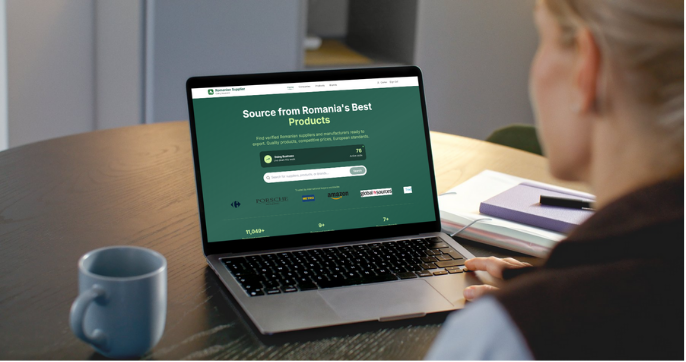
Romanian Supplier lists 11,113 registered Romanian companies. Every profile is reviewed before publication; company-declared details such as certifications and export markets are labelled as declared, not audited. This page explains the sources, the classification, the refresh cycle and how buyers should complete due diligence.
 Adrian Ambrose · Founder of Fabricat în RO (2014) · Owner of Romanian Supplier (2026)
In short. Romanian Supplier lists 11,113 Romanian companies (September 2026). Every profile identifies a real, registered Romanian business and is reviewed by our team before it is published. Company-supplied details — products, certifications, export markets, employee counts — are declared by the company or imported from trade data and are labelled as such; we do not audit factories. This page explains where each piece of data comes from, what "verified" does and does not mean on this platform, how often data is refreshed, and how a buyer should complete due diligence.
Where do the company profiles come from?
Profiles reach the platform in two ways.
Companies that register themselves. A Romanian manufacturer, exporter or service company creates an account, fills in its profile, uploads products, brands, solutions or services, and submits it. Nothing is published until an administrator has reviewed the submission. These profiles are the richest: they carry photographs, catalogues, product specifications and a direct messaging channel to the company.
Companies added from export data. The bulk of the directory — the roughly 11,000 profiles that make it useful as a map of Romanian industry — was built from records of Romanian companies with export activity, enriched with the company's public description, location and activity classification. Each record was matched to a registered legal entity and classified into one of 18 industries derived from the Harmonized System (HS) sections used in customs statistics. These companies can claim their profile at any time; until they do, the profile shows the imported information and a "listed" status.
What does "verified" mean on Romanian Supplier?
We use the word carefully. For every published profile we confirm that the company is a registered Romanian legal entity with the stated name and location, and that the profile was reviewed by a person before publication. We remove profiles when we learn that a company has been dissolved or cannot be matched to a registered entity.
We do not independently verify certifications, production capacity, export volumes or customer references. Those fields are declared by the company or derived from the imported trade data, and on imported profiles they can be generic. A certification shown on a profile is a claim to be checked with the issuing body, not a guarantee. If you see an obviously wrong detail, tell us and we will correct it.
How is the data classified?
Every company belongs to one or more of 18 industries: machinery & electrical equipment, metals, plastics & rubber, chemicals, textiles & apparel, furniture, wood, paper & packaging, optical & medical instruments, vehicles & transport equipment, stone, ceramics & glass, food & beverages, agriculture, leather, minerals & fuels, footwear, animal products, and fats & oils. The taxonomy follows the HS sections, so it maps directly onto Romania's customs export statistics and onto the categories buyers use when they search. Each industry has a directory page, for example metals & metal products, and can be combined with any of Romania's 41 counties plus Bucharest, for example textile manufacturers in Iași.
Locations are normalised to the county level from the address the company supplied; 99% of profiles resolve to a county. Export markets are recorded as the countries a company declares or that appear in its trade records.
How current is the data?
Claimed profiles are updated by the companies themselves and reviewed when they change. Imported profiles are refreshed in batches; the current dataset was classified in September 2026. Statistics quoted in our guides and articles carry the date on which they were extracted from the database, and the counts on directory pages are computed live.
How should a buyer complete due diligence?
Treat any listing — on this platform or on any other directory — as the start of a check, not the end of it. The steps that experienced buyers take before an order:
- Confirm the legal entity. Every Romanian company has a unique fiscal code (CUI). Its registration, VAT status and annual financial statements are public on the Ministry of Finance and Trade Registry websites, and EU VAT numbers can be validated in the VIES system.
- Validate certificates. ISO 9001, ISO 14001, IATF 16949 and similar certificates can be checked with the certification body that issued them or through the IAF CertSearch database. Ask for the certificate number and expiry date.
- Ask for references in your market. Two customer references or anonymised shipping documents to your country tell you more than any profile.
- Verify capability. For engineered products ask for a sample, a first-article inspection report or a short capability questionnaire; for food, textiles or furniture ask for the relevant scheme certificate (IFS/BRCGS, OEKO-TEX, FSC) and audit reports.
- Visit or audit. Romania is a two-hour flight from most of Europe; a one-day factory visit is the cheapest insurance on a new relationship. Third-party audits are widely available.
- Put terms in writing. Incoterms, payment terms, quality plan, tooling ownership and lead times, before the first purchase order.
Our guide to sourcing manufacturers in Romania covers each step in more detail.
What is the platform's business model?
Romanian Supplier is free for buyers. Romanian companies can list a basic profile free of charge and can pay for a premium subscription that adds catalogue uploads, more products and higher placement in listings; subscriptions are handled directly with our team, and paid placement never changes the facts shown on a profile. The platform is operated by Fabricat în RO, an organisation that has promoted Romanian producers since 2014.
Frequently asked questions
Are the companies on Romanian Supplier verified?
Each profile identifies a registered Romanian legal entity and is reviewed by our team before publication. Company-declared details such as certifications, capacity and export markets are not independently audited and should be validated with the company and the issuing bodies.
How many companies are listed on Romanian Supplier?
11,113 approved Romanian companies as of September 2026, across 18 industries and all 42 Romanian counties, plus 203 products, 56 brands, 53 services and 21 solutions uploaded by the companies themselves.
Can a company be removed or corrected?
Yes. Companies can claim their profile and edit it, and anyone can report an error. Profiles of dissolved companies are removed when we learn of them.
How can I check a Romanian company myself?
Use its CUI (fiscal code) on the Ministry of Finance portal for financial statements and VAT status, the Trade Registry (ONRC) for registration details, and the EU VIES service for VAT validation.
Topics
Adrian Ambrose
Founder of Fabricat în RO (2014) · Owner of Romanian Supplier (2026)
Adrian Ambrose founded Fabricat în RO in 2014, the Romanian platform and community that promotes products made in Romania — a marketplace and producer directory, promotion packages, a podcast with Romanian entrepreneurs and editorial guides that have supported more than 370 companies. Since 2026 he is the owner of Romanian Supplier, the export directory where international buyers find, verify and contact Romanian manufacturers. A marketing specialist with a background at ALTEN Group, he writes about sourcing from Romania, the country's export industries and the practical side of working with Romanian factories, drawing on the platform's database of more than 11,000 registry-checked companies.
LinkedInRelated guides

Romania exported about €93.6 billion of goods in 2024, mostly to the EU, led by electrical machinery, vehicles and industrial machinery. This guide maps the national export data onto the 11,113 Romanian suppliers listed on Romanian Supplier, industry by industry and county by county.
For industrial sourcing in Europe, buyers use Europages, Kompass, wlw and national directories such as Romanian Supplier; Alibaba stays the reference for Asian manufacturing. Here is how they compare on coverage, verification, cost and the categories each one is best for.

Dacia cars, Arctic appliances, Hora instruments, Jolidon swimwear, Borsec water, furniture, footwear and private-label food: ten products that show what Romanian factories do well, each linked to the supplier category it points to.